From brief to delivery
Commissioning a piece of furniture is not like buying one. There is no product page to add to a basket. Instead there is a conversation, a series of decisions made together, and a build that happens over several weeks with the client involved at each stage. This page describes how that process works at New Design London, from the first email to the moment the piece arrives in the room it was made for.
1. The first conversation
Most commissions begin with an email. It does not need to be detailed — a sentence or two about the piece, the room, the timing, and roughly the budget is enough. Some clients send photographs of the room; some send reference images of pieces they admire; some arrive with nothing more than a feeling about what the room needs.
From that email, we arrange either a phone call or a visit to the workshop. The purpose of the first conversation is not to design anything — it is to understand the room, the way the client uses it, and what the piece needs to do. A sofa for a family with young children has different priorities than a sofa for a couple who read in the evenings. A dining chair for three-hour dinner parties is a different brief from a dining chair for quick weekday meals.
By the end of the first conversation, we usually have enough to begin sketching.
2. Sketches and the written quote
Within about a week of the first conversation, the workshop produces initial sketches and a written quote. The sketches are hand-drawn or simple digital renders — not photorealistic, but clear enough to show proportion, shape, and scale in relation to the room. We typically present two or three variations: different arm heights, back angles, or frame shapes, with notes on the trade-offs of each.
The written quote covers materials, dimensions, build timeline, and total cost. It also lists what is included (delivery, for example) and what is quoted separately (bespoke fabric sourcing, if the client wants something outside the standard mill partners). The quote is valid for 30 days and includes no hidden costs — if something changes during the build, we surface it before proceeding.
3. Sign-off and materials
Once the client approves a sketch and accepts the quote, a deposit secures the build slot in the workshop calendar. The deposit is typically 50% of the total, with the balance due on completion before delivery.
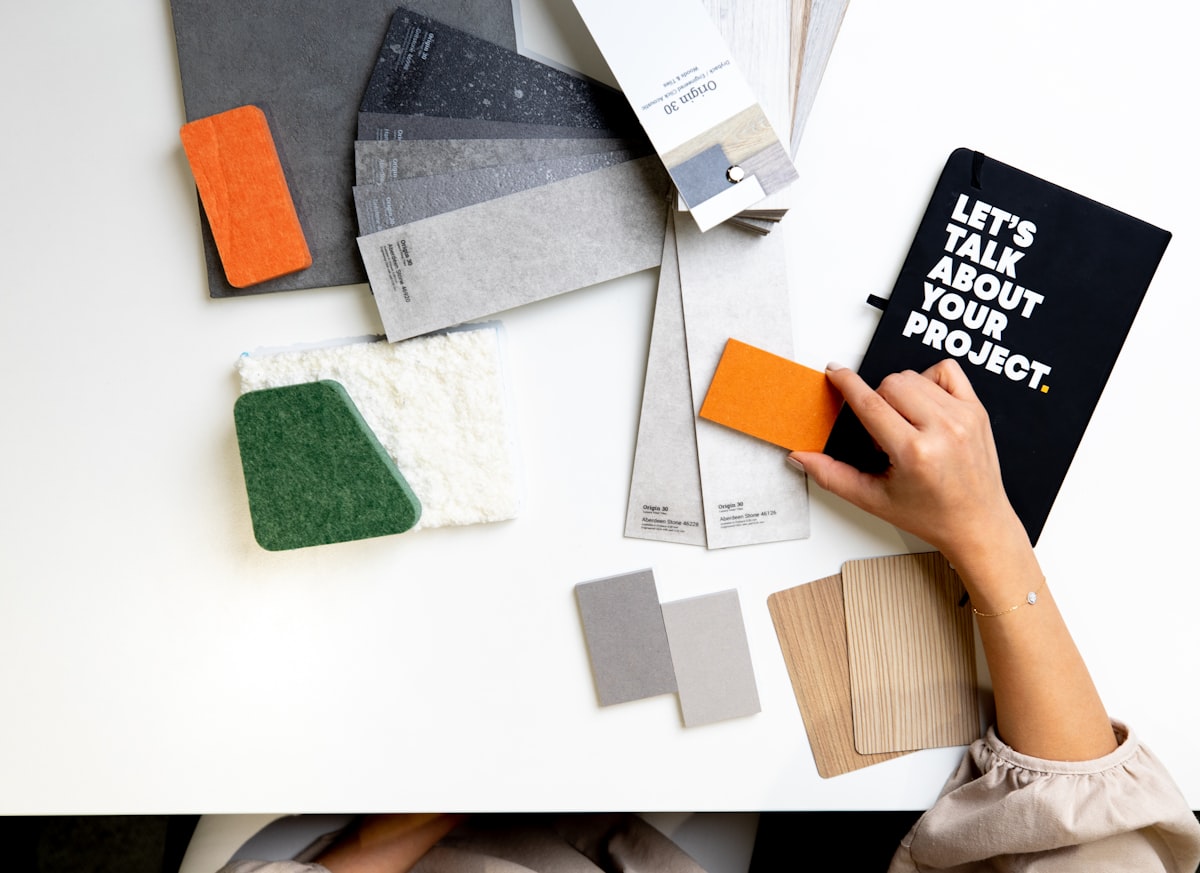
At this stage we finalise materials. For upholstered pieces, this means choosing the fabric — clients can visit the workshop to see and feel swatches, or we post sample cuttings. We work with a small number of established UK and European fabric mills whose quality we trust over the long term. If a client has a fabric in mind from outside those partners, we will assess it honestly: some fabrics do not suit certain constructions, and we would rather say so upfront than let a beautiful but fragile fabric fail within a few years.
For timber-frame pieces, the choice is usually between beech (strong, predictable, the workhorse of upholstered furniture frames) and oak or walnut (for exposed-frame designs where the wood is part of the aesthetic). We source from UK timber merchants with chain-of-custody certification.
4. The build
Building happens in the workshop. The sequence is consistent regardless of the piece:
- Frame construction. Cutting, joinery, assembly. Hardwood frames are built with traditional mortise-and-tenon or dowelled joints, glued and clamped. No staples in structural joints; no MDF where strength matters.
- Suspension. Depending on the design: serpentine springs, elasticated webbing, or (for some bench-style pieces) a solid platform. The suspension determines how the piece feels to sit on — sprung pieces have more give; webbed pieces have a firmer seat.
- Upholstery layers. HR foam cut to shape, layered with dacron wrap for surface softness. Some designs use a feather-wrap layer over the foam for a more relaxed, less structured feel — this is always a conversation, because feather layers require occasional plumping and they read differently over time.
- Fabric application. The outer fabric is applied last, stretched, pinned, and hand-stitched or stapled to the underframe depending on the construction type. Pattern matching on striped or patterned fabrics is done at this stage.
- Finishing. Legs fitted, any exposed timber oiled or lacquered, fabric protected if requested. The piece is inspected, measured against the original spec, and photographed.
Throughout the build, the client can follow along via progress photographs sent by email. Most clients appreciate seeing the bare frame — it makes the quality of the underlying construction visible in a way that the finished piece, once upholstered, no longer shows.
5. Delivery and installation
The workshop handles delivery directly — no third-party courier for London and the Home Counties. We deliver in a covered van, carry the piece in, and position it in the room. For larger pieces (sectional sofas, beds), we confirm access dimensions before the build begins; if a piece cannot fit through a doorway or up a staircase, we need to know before the frame is assembled at full size.
National delivery (outside London and the Home Counties) is quoted separately and uses a specialist furniture courier with blanket protection and two-person handling.
The balance payment is due on delivery, once the client has confirmed the piece in the room.
6. After delivery
All pieces carry a structural guarantee: the frame is built to last fifty years under normal domestic use, and if a joint fails or a frame member breaks within that period, we repair or replace it at no cost. Upholstery wear is not covered (fabric life depends on use and the fabric chosen), but we offer re-upholstery services for pieces we have made — the frame is designed to be re-covered without dismantling.
Many clients return for additional pieces once the first one is in place. A sofa leads to a footstool; a bed frame leads to a bench. We keep records of every commission — dimensions, materials, finishes — so that subsequent pieces can be designed to sit alongside earlier ones coherently.
Ready to begin?
Email [email protected] with a sentence or two about the piece you are considering. A first reply usually comes within a working day.